
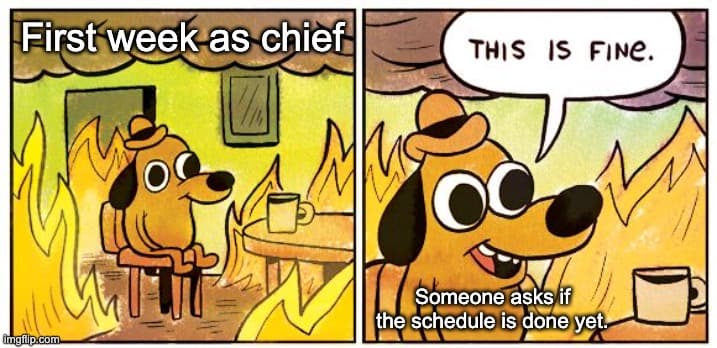
Congratulations — you've been elected as chief! That's genuinely exciting, and also a lot.
At some point in the next few weeks, someone's going to hand you the
schedule. It might be a spreadsheet, a PDF with color-coded rotations, an
app, or a folder of files with names like FINAL_v3_SCHEDULE.xlsx. Either
way, it's yours now.
Over the past year, I've spoken with dozens of chief residents across internal medicine, OB/GYN, and surgical programs. When I ask what surprised them most about their first weeks, the answer is almost always the same.
The schedule.
Not the emails. Not the politics of managing peers who are also your friends. It's the schedule, and specifically, the moment they realized no one had really prepared them for it.
One chief told me she built her first schedule during overnight ICU call. "I'd finish a note and open Excel. Finish another note. Open Excel." She got it done. But it took six weeks and a near-complete rebuild in week five when she realized she'd missed a rule.
This is what I wish someone had given her on day one.
Before you open the Excel
The residency scheduling calendar doesn't pause for your orientation. By the time you're named chief, right about now in Match, the new academic year is already 3–4 months away. You have 30, 60, sometimes 150+ residents to place across dozens of rotations, ACGME compliance requirements to satisfy, and individual training needs to accommodate. And it's happening while you're still a resident yourself.
Most chiefs skip straight to building and sometimes regret it. Here's what I learned from them along the way:
1. Get the rules in writing. Every program has scheduling rules. Some are ACGME requirements — the 80-hour weekly limit, maximum 24-hour continuous duty, minimum 8 hours between shifts. Some are program-specific. Most exist only in someone's memory, like your PD's or ex-chief's. Ask your outgoing chief to write down every rule they actually follow. Not the ones in the GME manual — like the real ones. The "we never put a resident on night float the week before boards" rules. The rules that aren't rules until you break them.
2. Separate hard rules from soft ones. Hard rules cannot be violated. ACGME duty hour limits. Graduation requirement rotations. These are non-negotiable. Soft rules are preferences you try to honor but can flex — a resident's request to avoid call the week of a wedding, or a preference against three consecutive night floats. Know which is which before you build a single rotation. Good news: this usually comes easily to chiefs too, because you've lived the schedule intimately for the last few years, so you know what works and what doesn't.
3. Audit last year's schedule for where it broke. Ask your outgoing chief: where did problems arise last year? Which rotations created conflict every time? What should I look out for? This institutional knowledge doesn't exist anywhere else. Extract it before it walks out the door.
4. Keep an open line with your program director — early. This one sounds obvious, but it's where a lot of chiefs get burned. You can spend weeks building a schedule only to have your PD flag a preference — someone needing a leave of absence, a resident requiring additional support throughout the year, a rotation that needs rethinking. Things that completely change the math. It's one of the most frustrating parts of the job, and most of it is avoidable with a single early conversation.
Before you go deep on any draft, walk your PD through your approach. Ask upfront: is anyone going on leave? Does anyone need additional support or flexibility this cycle? Get that information before you build, not after. Their sign-off isn't just a rubber stamp — it's the difference between shipping the schedule and starting over.
The tools chiefs actually use
Here's an honest look at the landscape.
| Tool | What's good | Issues |
|---|---|---|
| Excel / Google Sheets | Flexible, familiar, free; multi-access | Formulas for fairness tracking; versioning problems; difficult compliance checking |
| Amion | Publish directly from scheduler to residents; attendings already use it | Steep learning curve; might not be able to account for all your rules |
| QGenda | Dedicated support; genuinely robust, especially for large systems | Expensive for programs; usually a hospital-wide purchase |
| Startups (like us) | Flexible and bespoke; fast | Might not have a full stack of features like a mobile app etc. |
Most programs land on Excel by default, not because it's the best tool, but because it's the easiest to start with. For 15 residents and a simple rotation structure, it works.
But as your program grows or rules get more complex, Excel stops being a tool and starts becoming a burden. A chief once said: "I realized I'd been maintaining a fragile puzzle, where every piece moved when I touched it." The schedule doesn't get easier. The tool should.
One last thing
If you've read this far, I already know something about you.
Most chiefs want the best for their residents. That's not a given — it's a choice. And the fact that you're here, thinking carefully about how to do this well before you've even started, says a lot.
Fairness isn't just a nice-to-have in residency scheduling. It's the thing that makes or breaks team culture. Residents notice when the weekends aren't distributed equitably. They notice who's always on call during the holidays. And you've been in their shoes before. They might not say it out loud, but they notice. As chief, you set the standard for what fair looks like, as much as you can.
That's the part no scheduling software can do for you right now. The judgment, the care, the intention to make it right for your team — that's yours. The best chiefs I've spoken to aren't just building a schedule. They're building a team. So do it with intention, because the residents you lead will remember it.
What we're building at Standard Form
This is exactly what we've been thinking about at Standard Form. As a physician and someone who's now spoken to dozens of chiefs about this exact problem, I've seen how much invisible work goes into getting the schedule right.
The goal isn't to replace the chief resident's judgment. The goal is to take the mechanical grunt work — the constraint checking, the equity tracking, the "does this violate the 80-hour rule" calculations — off your plate.
Standard Form lets chiefs define their scheduling rules in plain English and generates ACGME-compliant schedules in minutes. If you're heading into your first year as chief and want to see what that looks like in practice, we'd love to show you. Book a demo — it's 30 minutes and I promise we won't make you sit through slides.
And if you're still on Excel and want a walkthrough on how to build a residency schedule in it properly, I'm happy to do that too. Just let me know.
Thanks to the many chief residents who shared their experiences with me over the past year.